
⇐ Arm folding |
Attached earlobe ⇒
Table of Contents
Genetics of asparagus urine
Summary
You may have noticed that your urine smells really bad after you eat asparagus, and you may have heard that this is a dominant genetic trait. It's actually more complicated than that! Some people excrete stinky sulfur compounds after they eat asparagus, and some people don't. But in addition, some people can smell the sulfur compounds in asparagus urine and some can't. If you don't smell anything in your own asparagus urine, it could be because you don't secrete, you don't smell, or both. Producing stinky asparagus urine may be controlled by a single gene, with excreting dominant to non-excreting, but more research is needed to test this.
Asparagus urine: variation in excretion, in smelling, or both?

People have known for a long time that after eating asparagus, some people find that their urine has a strong, unusual smell. Pegiou et al. (2020) give a good historical review, including quotes from the 1700s about stinky asparagus urine. Other people don't notice anything unusual after eating asparagus. There are two possible explanations for this: some people excrete smelly compounds in their urine after eating asparagus, while other people don't excrete them; or some people can smell the compounds, while other people can't.
Unfortunately, many of the papers on asparagus urine are short and lack detail. Allison and McWhirter (1956) were the first to suggest that there was genetic variation, using a chemical test for methanethiol (a stinky sulfur compound) and finding that 46 out of 115 people excreted methanethiol in their urine after eating asparagus. Unfortunately, Allison and McWhirter (1956) did not say what method they used to detect methanethiol. In response to criticism (Penrose 1957) of their study, Allison and McWhirter (1957) stated that methanethiol was clearly either present or absent; again, they gave no details about the chemical test they used, which is really sloppy and annoying.
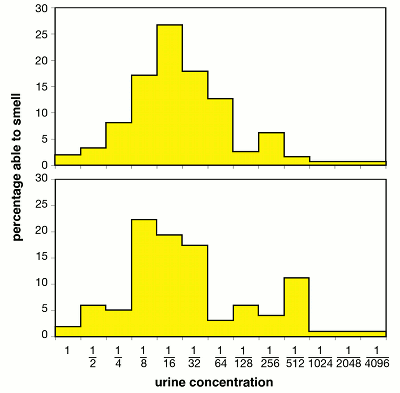
Lison et al. (1980) took asparagus urine from a single individual and asked 328 people to smell different dilutions and find the lowest concentration that they could distinguish from tap water. They found a lot of variation among individuals, then divided them into "smellers" and "non-smellers." They also had 10 "smellers" smell the urine of 11 "non-smellers," and all of the smellers could distinguish asparagus urine from normal urine. Based on the second experiment, they concluded that everyone excretes the smelly substances, but there is variation in ability to smell them.
Hoffenberg (1983) took asparagus urine from a single individual and had 98 schoolchildren find the lowest concentration that they could distinguish from tap water. The distribution was somewhat bimodal, but as in Lison et al. (1980), there was not a clear gap between smellers and non-smellers. Both Lison et al. (1980) and Hoffenberg (1983) asked people to distinguish between the odors of asparagus urine and tap water, not between asparagus urine and normal urine. This is a textbook example of a badly controlled experiment, because you can't tell whether the smellers are smelling asparagus compounds or compounds present in all urine.
Mitchell et al. (1987) fed asparagus to 800 volunteers and then collected their urine. Three smellers then smelled their asparagus urine and a control sample of normal urine and classified the urine samples as smelly or not. All of the smellers agreed about the classification of all of the samples, which is a good indication that urine can be classified into two discrete types. Of the sample, 43% produced stinky urine.
Waring et al. (1987) identified five people who produced stinky urine and three who did not, then used gas chromatography and found five sulfur compounds that were present in the stinky urine but not the non-stinky urine. This is further evidence that not everyone excretes the compounds.
Richer et al. (1989) fed asparagus to 103 people and reported that all of them produced stinky urine. Unfortunately, they do not say how they assayed stinkiness.
Erickson et al. (2010) used a web-based survey form to ask customers of the 23andMe genomic company whether they had noticed an unusual smell after eating asparagus, and 63 percent of 4742 people said they had. Of course, it is unknown whether the people who hadn't noticed an odor were non-excretors or non-smellers.
Pelchat et al. (2011) asked people whether they could distinguish between asparagus and normal urine from other people in the study. They found that 3 out of 37 people produced asparagus urine that none of the other people could distinguish from normal urine, which means that some people really are non-excretors. Out of 31 people, 2 could not distinguish between the asparagus and normal urine of any of the subjects, meaning that there really are non-smellers. There was continuous variation in both excretion and smelling ability, as well; the asparagus urine of some people was easily detected by most of the people, while other people produced asparagus urine that only some people could detect.
Lison et al. (1980) and Richer et al. (1989) concluded that everyone excretes stinky compounds in their urine after eating asparagus, and the only variation is in ability to smell them. Other papers using chemical tests and carefully controlled smelling tests show that there is variation in excretion of sulfur compounds in urine after eating asparagus. The lack of detail in some of the papers makes it difficult to be sure, but it may be that everyone, if fed enough asparagus, excretes enough stinky compounds that a careful sniff by a sensitive nose can distinguish the asparagus urine from non-asparagus urine. It may be that only some people excrete large enough amounts of stinky compounds to be noticably unusual. Quantitative chemical analysis of sulfur compounds in the urine of a sample of asparagus eaters would be an obvious way to shed light on this.
It is clear that in addition to variation in excretion, there is also variation in the ability to smell the compounds. It is not clear whether this variation is continuous, or whether people can be clearly divided into smellers and non-smellers. Testing the ability of people to smell different concentrations of the sulfur compounds that are hypothesized to be the cause of the odor, such as methanethiol and dimethyl sulfide, would help resolve this question.
What is being smelled?
Despite a number of studies, it is not entirely clear what compounds are responsible for the odor in asparagus urine. Nencki (1891) identified methanethiol (a sulfur compound, also known as methyl mercaptan) in asparagus urine, and Allison and McWhirter (1956) found that is was present in the urine of some asparagus eaters and absent in others' urine. White (1975) used gas chromatography on methylene chloride extracts of asparagus urine and identified S-methyl thioacrylate and S-methyl 3-(methylthio)thiopropionate; he suggested that these compounds would be easily broken down into methanethiol, thus explaining the earlier results. He found that adding S-methyl thioacrylate and S-methyl 3-(methylthio)thiopropionate to normal urine made it smell like asparagus urine.
Waring et al. (1987) criticized previous studies for analyzing compounds in the liquid urine, not just those volatile enough to be smelled, and for using chemical extraction methods involving heat, time, and organic solvents that could cause chemical modifications in the urine. They used gas chromatography of the vapor above urine, and they identified five compounds that were present in the asparagus urine vapor of five excretors but absent in the vapor of three non-excretors: methanethiol, dimethyl sulphide, dimethyl disulphide, dimethyl sulphoxide, and dimethyl sulphone. By having smellers smell the different compounds, they found that a mixture of methanethiol and dimethyl sulfide was similar in smell to asparagus urine.
Leitner (2001) also used gas chromatography of vapors, and he identified twelve different sulfur compounds that were present in the vapors above asparagus urine but absent in normal urine. These included methanethiol and dimethyl sulphide, which Waring et al. (1987) identified as the sources of the distinctive odor.
Small, volatile molecules such as methanethiol and dimethyl sulfide would be lost in cooking, so there must be a more stable compound that is unique to asparagus and gets broken down in the body to produce the stinky compounds in asparagus urine. Asparagusic acid and its derivatives, such as dihydroasparagusic acid, are sulfur-containing compounds that are found in asparagus but not in related vegetables and which may act as plant growth inhibitors (Yanagawa et al. 1972) and to kill nematodes (Takasugi et al. 1975). Jansen (1948) fed 10 mg of dihydroasparagusic acid to two subjects and said their urine did not stink, but he did not say whether these two people were known to produce stinky urine after eating asparagus. Waring et al. (1987) fed asparagusic acid to two people known to produce stinky asparagus urine, and their urine stank; they also fed asparagusic acid to one person known to produce non-stinky asparagus urine, and that person's urine did not stink. While more detail about this experiment would be helpful, such as the amount of asparagusic acid used, it seems likely that the asparagusic acid in asparagus gets metabolized into smaller sulfur-containing compounds and excreted by some people. There are no data on whether non-excretors fail to absorb the asparagusic acid, fail to metabolize it, or fail to excrete the products of metabolism.
Family studies
Allison and McWhirter (1956) compared parents and offspring, using a chemical test to separate excretors (E) from non-excretors (NE):
| Parents | E offspring | NE offspring |
|---|---|---|
| E×E | 1 | 1 |
| E×NE | 5 | 7 |
| NE×NE | 0 | 11 |
They concluded that excretion of sulfurous compounds in urine after eating asparagus is controlled by a single gene, with the allele for excretion dominant over the allele for non-excretion.
Mitchell et al. (1987) performed a similar study, except they used three smellers to distinguish between the urine of excretors and non-excretors, and found similar results:
| Parents | E offspring | NE offspring |
|---|---|---|
| E×E | 19 | 3 |
| E×NE | 17 | 9 |
| NE×NE | 0 | 7 |
It would be better to have larger sample sizes and a more quantitative method of distinguishing excretors from non-excretors, but the available data are completely consistent with excretion being determined by a single gene with two alleles, with excretion dominant to non-excretion.
Surprisingly, there are no family studies on the ability to smell the stinky compounds in asparagus urine, and no twin studies on either trait (excreting or smelling).
Genome studies
Erickson et al. (2010) surveyed customers of 23andMe, a company which genotyped the individuals at 535,076 single-nucleotide polymorphisms (SNPs). They asked 10,000 customers of northern European ancestry "Have you ever noticed a peculiar odor when you pee after eating asparagus?" and received 4737 responses. There was a statistically strong association between the answers and a region on chromosome 1 containing 10 olfactory receptor genes. At the single nucleotide polymorphism (SNP) with the strongest association, a G/A polymorphism in the SNP rs4481887, 57% of GG, 71% of GA, and 74% of AA individuals reported stinky asparagus urine.
Pelchat et al. (2011) performed a carefully designed, well controlled experiment (a first in the long history of asparagus urine research!) that separated the two traits, excreting stinky compounds and being able to smell them, and determined genotypes for the rs4481887 SNP that Erickson et al. (2010) found. They found an association of SNP genotype with the ability to smell asparagus urine, but no significant association with excreting. The rs4481887 SNP is in a region with several odor receptor genes and a high level of linkage disequilibrium, so it is not clear which gene is responsible.
Markt et al. (2016) asked 6909 people whether they noticed a strong odor in their urine after eating asparagus, and identified numerous SNPs associated with this trait, in the same region of chromosome 1 as found in Erickson et al. (2010) and Pelchat et al. (2011).
The family studies show that whether you make smelly urine after you eat asparagus is a genetic trait, with making smelly urine being dominant, but no one has done genomic studies to find the gene responsible. The genomic studies have shown that being able to smell the compounds in asparagus urine is influenced by genetics, but they haven't shown whether the inheritance is simple (single gene, two alleles, one allele completely dominant over the other), or something more complicated.
Further research
It would be great to have ways of measuring the two traits (excreting and smelling), to see whether the variation in these traits varies smoothly across a range, or whether people really fall into two discrete categories for each trait. White (1975), Waring et al. (1987), and Leitner (2001) used gas chromatography to identify sulfur compounds in asparagus urine, and Allison and McWhirter (1956) used a chemical assay for sulfur compounds; it ought to be possible to use these techniques to measure the amount of sulfur compounds in asparagus urine from a number of people.
Most studies of the smelling trait have either asked people to smell their own urine (which mixes up excreting and smelling), or asked people to smell other people's urine, which is not very reproducible (and kind of disgusting). I think it would be better to have people smell controlled amounts of the chemicals that are thought to cause asparagus urine smell (methanethiol and dimethyl sulphide), but I don't think anyone has tried this as a way to measure the traits.
References
Allison, A. C., McWhirter, K. G. 1956. Two unifactorial characters for which man is polymorphic. Nature 178: 748-749.
Allison, A.C., and K.G. McWhirter. 1957. Two new human genes. British Medical Journal 1: 585.
Eriksson, N,, J.M. Macpherson, J. Tung, L. Hon, B. Naughton, S. Saxonov, L. Avey, A. Wojcicki, I. Pe'er, and J. Mountain. 2010. Web-based, participant-driven studies yield novel genetic associations for common traits. PLoS Genetics 2010. 6:e1000993.
Hoffenberg, L. 1983. A note on polymorphism: the ability to smell urinary metabolites of asparagus. Diastema 11:37-38.
Jansen, E.F. 1948. The isolation and identification of 2,2'-dithiolisobutyric acid from asparagus. Journal of Biological Chemistry 176: 657-664.
Leitner, E. 2001. Identification of odorous compounds in urine after the consumption of asparagus. Recent Research Developments in Agricultural and Food Chemistry 5:161-166.
Lison, M., S. H. Blondheim, and R. N. Melmed. 1980. A polymorphism of the ability to smell urinary metabolites of asparagus. British Medical Journal 281: 1676-1678.
Markt, S.C., et al. (13 coauthors). 2016. Sniffing out significant “Pee values”: genome wide association study of asparagus anosmia. British Medical Journal 355: i6071.
Mitchell, S. C., R.H. Waring, D. Land, and W. V. Thorpe. 1987. Odorous urine following asparagus ingestion in man. Experientia 43: 382-383.
Nencki, M. 1891. Ueber das Vorkommen von Methylmercaptan im meschlichen Harn nach Spargelgenuss. Archiv fur experimentalle Pathologie und Pharmacokologie 28: 206-209.
Pegiou, E., R. Mumm, P. Acharya, R.C.H. de Vos, and R.D. Hall. 2020. Green and white asparagus (Asparagus officinalis): A source of developmental, chemical and urinary intrigue. Metabolites 10: 17.
Pelchat, M.L., C. Bykowski, F.F. Duke, and D. R. Reed. 2011. Excretion and perception of a characteristic odor in urine after asparagus ingestion: a psychophysical and genetic study. Chemical Senses 36: 9-17.
Penrose, L.S. 1957. Two new human genes. British Medical Journal 1: 282.
Richer, C., N. Decker, J. Belin, J. L. Imbs, J. L. Montastruc, and J. F. Giudicelli. 1989. Odorous urine in man after asparagus. British Journal of Clinical Pharmacology 27:640-641.
Takasugi, M., Y. Yachida, M. Anetai, T. Masamune, and K. Kegasawa, K. 1975. Identification of asparagusic acid as a nematicide occurring naturally in roots of asparagus. Chemistry Letters 1975: 43-44.
Waring, R. H., S. C. Mitchell, and G. R. Fenwick. 1987. The chemical nature of the urinary odour produced by man after asparagus ingestion. Xenobiotica 17:1363-1371.
White, R.H. 1975. Occurrence of S-methyl thioesters in urines of humans after they have eaten asparagus. Science 189: 810-811.
Yanagawa, H., T. Kato, Y. Kitahara, N. Takahashi, and Y. Kato. 1972. Asparagusic acid, dihydroasparagusic acid and S-acetyldihydroasparagusic acid, new plant growth inhibitors in etoilated young Asparagus officinalis. Tetrahedron Letters 2549-2552.
Go to John McDonald's home page
This page was last revised October 26, 2026. ©2026 by John H. McDonald. Content is available under the Creative Commons Attribution-Noncommercial license.