
⇐ Beeturia |
Blue eyes ⇒
Table of Contents
Genetics of bent little finger
Summary

You may have heard that there are two kinds of fifth fingers ("pinkies"), bent pinkies that bend in towards your ring fingers when you put your hands flat on a table and straight pinkies, and you may have heard that bent pinkie is a dominant genetic trait. Neither part of that is true! There is just smooth variation in pinkie angle, from straight to sharply bent and everything in between, not two distinct categories. And studies of families show that it's not a caused by a dominant allele. Don't worry if your family includes two straight-pinkie parents with a bent-pinkie child, and if you're a teacher, don't use bent pinkie as an example of a simple genetic trait.
Are there just two kinds of pinkies?
Little fingers range from perfectly straight to bending inwards at a sharp angle. Most studies have subjectively divided pinkies into "straight" vs. "bent." It's not surprising that estimates of the proportion of people with bent pinkies range from 0.1% (Hersh 1953) to 33% (Roche 1961), since different researchers will have different ideas about what to call "bent." Lee et al. (2022) scanned the hands of 1295 adults and measured the angle between the first two phalanges and the last on on the pinkie. They found a continuous distribution, which means that there aren't just two types of pinkies, straight vs. bent. Dividing pinkies into two categories is as arbitrary and unscientific as dividing all people into two categories, "tall" and "normal."
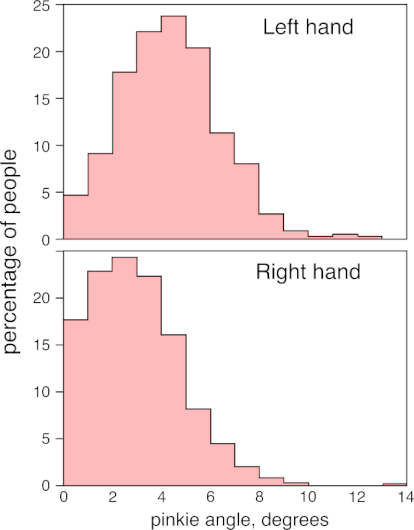
The technical name for a little finger bending in towards the ring finger is clinodactyly; that's what the genetic myth is about. Extremely bent pinkies can be straightened with surgery (Moeller 2019), although it's not recommended unless the angle is so extreme that it interferes with normal hand functions, such as making a fist (Flatt 2005).
There's another condition, called streblomicrodactyly, streblodactyly or camptodactyly, in which the little finger bends in towards the palm (it can't be completely straightened). There are a few genetic studies of this condition, but it's not one of the myths used in teaching human genetics, so I won't talk about it here.
Family studies
All of the studies of the inheritance of bent pinkies subjectively divide pinkies into straight vs. bent, so they're pretty worthless. Hersh et al. (1953) used data from 21 matings to conclude that bent was caused by a dominant allele, but there were 4 B and 2 S offspring of two S parents, which is more consistent with B being recessive (they didn't have any matings with two B parents).
Ordu and Nwosu (2015) found the following results:
| Parents | B offspring | S offspring | Percent B |
|---|---|---|---|
| B×B | 20 | 12 | 62% |
| B×S | 62 | 98 | 39% |
| S×S | 12 | 88 | 12% |
They concluded that B was dominant, but the 12 B offspring of two S parents don't fit this. Clearly there is some genetic influence on pinkie angle, since two B parents are more likely to have a B offspring than two S parents, but the data don't fit the textbook model of two alleles with B dominant.
Genome studies
Lee et al. (2025) measured the pinkie angle (instead of just dividing pinkies into straight vs. bent) and looked for associations between about 1.8 million genetic markers and pinkie angle in over 600 people. They did not find any genetic markers that were associated with pinkie angle. This is pretty strong evidence that pinkie angle is not a ganetic trait.
Further research
Several studies found that bent pinkies are more common in people with Down syndrome than in people without Down syndrome (West 1901, Roche 1961). I don't know what this tells us about either Down syndrome or pinkies, so I can't see any reason to follow up on it.
I can't think of any other reason for anyone to do more research on pinkie angles.
References
Flatt, A.E. 2005. The troubles with pinkies. Baylor University Medical Center Proceedings 18: 341-344.
Hersh, A.H., F. DeMarinis, and R.M. Stecher. 1953. On the inheritance and development of clinodactyly. American Journal of Human Genetics 5: 257-268.
Moeller, A. 2019. Clinodactyly. Techniques in Orthopaedics 34: 18-25.
Lee, M.K., Z.T. Dahl, J. Anderton, J.L. Maurer, M.L. Marazita, J.R. Shaffer, and S.M. Weinberg. 2022. Bent pinkies: Quantifying fifth finger clinodactyly in a sample of U.S. adults. PLoS ONE 17: e0271734.
Lee, M.., N. Herrick M.L. Marazita, J.R. Shafer, and S.M. Weinberg. 2025. Genome-wide scan of fifth finger clinodactyly. Molecular genetics and genomic medicine 13:e70090.
Ordu, K.S., and N.C. Nwosu. 2015. Little finger curvature: a morphogenetic trait inherited by Mendelian pattern among the IGBO ethnic group of Nigeria. Discovery Genetics 1: 6-11.
Roche, A.F. 1961. Clinodactyly and brachymesophalangia of the fifth finger. Acta Paediatrica 50: 387-391.
West, T.T. 1901. A note on the little finger of the mongolian idiot and of normal children. Archives of Pediatrics 18: 918-924.
Go to John McDonald's home page
This page was last revised October 26, 2026. ©2026 by John H. McDonald. Content is available under the Creative Commons Attribution-Noncommercial license.