
|
Arm folding ⇒
Table of Contents
Introduction to the Myths of Human Genetics
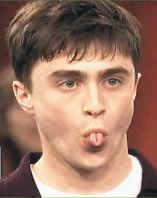
A lot of biology teachers like to teach the basics of genetics by having students look at traits on themselves. If you've taken some biology classes, you've probably been asked to roll your tongue, look at your earlobes, or check whether your thumbs are straight or bent. It's fun and easy to collect data on several different traits and learn about genes, dominant and recessive alleles, maybe even Hardy-Weinberg proportions. Best of all, studying these traits doesn't require microscopes, petri dishes, or stinky fruit-fly food.
Unfortunately, what textbooks, lab manuals and web pages say about these human traits is mostly wrong. Most of the common, visible human traits that are used in classrooms do NOT have a simple one-locus, two-allele, dominant vs. recessive method of inheritance. Rolling your tongue is not dominant to non-rolling, unattached earlobes are not dominant to attached, straight thumbs are not dominant to hitchhiker's thumb, etc.
In some cases, the trait doesn't even fall into the two distinct categories described by the myth. For example, a biology teacher may have told you that you either have a hitchhiker's thumb, which bends backwards at a sharp angle, or a straight thumb. In fact, the angle of the thumb ranges continuously, with most thumbs somewhere in the middle. This was clearly shown in the very first paper on the genetics of hitchhiker's thumb (Glass and Kistler 1953), yet 73 years later, teachers still ask students which of the two kinds of thumb they have.
In other cases, the trait really does fall into two categories, but it isn't determined by genetics. For example, some teachers ask students to fold their arms, then say that the allele for having the right forearm on top is dominant over the allele for having your left arm on top. But the very first study on the subject (Wiener 1932) clearly showed that there is little or no genetic influence on this trait: pairs of right-arm parents are just about as likely to have right-arm children as are pairs of left-arm parents.
Some traits, such as tongue rolling, were originally described as fitting a simple genetic model, but later research revealed them to be more complicated. Other traits were shown from the very beginning to not fit the simple genetic model, but somehow textbook authors decided to ignore this. A quick search in the standard reference on human genetics, Online Mendelian Inheritance in Man (OMIM), makes it clear that most of these traits do not fit the simple genetic model. It is an embarrassment to the field of biology education that textbooks and lab manuals continue to perpetuate these myths.
Who's my daddy?

If you're a teacher, you might argue that using traits like tongue rolling and arm folding to teach genetics is a useful "lie-to-children," an oversimplification that is useful for teaching beginners, like teaching students in elementary school that electrons are little balls that revolve around the nucleus of an atom in little circular orbits. They can learn about polygenic traits, incomplete penetrance, and environmental effects in later biology classes, at the same time they're learning the quantum model of electrons in their physics classes.
However, there is big problem with teaching inaccurate human genetics. Let's say you tell your students that arm folding is a genetic trait, with the allele for right forearm on top (R) being dominant to left forearm on top (L). They all fold their arms and see which arm is on top, write the results in a worksheet, do Punnett squares with big R's and little l's. Then they go home and ask their parents to fold their arms, so they can finish filling out the worksheet. Results from a large number of studies show that about 11 percent of your students will be R children of two L parents; if they understand the genetics lesson correctly, they will conclude that either they were secretly adopted, or Mom was fooling around and Dad isn't their biological father. More of your students will reach this conclusion with each bogus genetic trait that you add to the worksheet. I don't think convincing your students that their parents have been lying about their parentage is good way to teach genetics!
You could use accurate genetic traits for a classroom exercise, such as earwax, blood types, or DNA markers. However, some of your students really aren't the biological offspring of the people they call Mom and Dad. The most common cause of this is a woman having an affair with someone other than her husband or partner. Several genetic studies, mostly in European and North American populations, have found that the rate of this "paternal discrepancy" is about 4 percent of all children (Bellis et al. 2005), which means that a typical classroom is likely to have at least one child who doesn't know that the person they call "Dad" isn't their biological father. Less commonly, parents don't tell their children that they are adopted or are the product of artificial insemination or egg donation, and I suppose switched-at-birth hospital mixups happen occasionally. So if you use earwax or blood groups or DNA for a classroom exercise in genetics, some of your students may learn both Punnett squares, AND that their family belongs on a lurid daytime talk show.
Alternatives to human traits
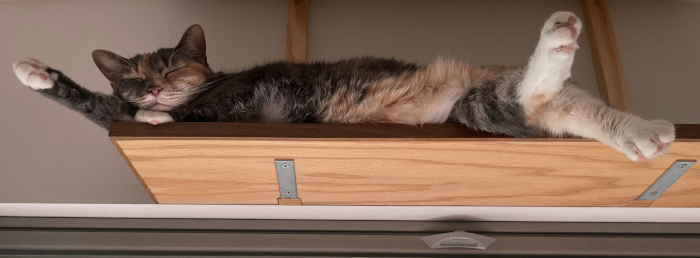
Because of all the problems with using human traits, I prefer to use cat coat characters when teaching basic genetics. Hair length (long vs. short), orange vs. black, and white spotting are three traits that really do fall into discrete categories and really are controlled by a single gene. I've put together a page about the three cat traits I've used, and the Wikipedia page on cat coat genetics has information on a number of other easily observable genetic traits in cats.
If you really must use human traits as examples in your genetics class, there are a number of genetic disorders that are caused by a single gene with two alleles, such as cystic fibrosis, sickle cell, Huntingtons, Tay-Sachs, hemophilia, etc. But you'll just be talking about them, not observing them, which is kind of boring.
Summary for worried parents and children
For each of these human traits, there is a myth that one form is recessive. If that were true, two parents with the recessive trait could not have a child with the dominant trait, so if that's what your family looks like, you might be worried. Here's a quick listing of the reality about each of these traits.
Can two parents who fold their arms with the left arm on top have a child who folds with the right arm on top? Yes.
Can two parents with attached earlobes have a child with unattached earlobes? Yes.
Can two parents who produce red urine after they eat beets have a child who makes yellow beet urine? Yes.
Can two parents with straight pinkies have a child with a bent pinkie? Yes.
Can two parents with smooth chins have a child with a cleft chin? Yes.
Can two parents without a bump inside their ear ("Darwin's tubercle") have a child with this bump? Yes.
Can two blue-eyed parents have a child with brown, green or hazel eyes? Yes.
Can two red-haired parents have a child with blond or brown hair? Yes.
Can two parents whose hair whorls counterclockwise on the back of their head have a child whose hair whorls clockwise? Yes.
Can two parents who clasp their hands with the left thumb on top have a child who clasps hands with the right thumb on top? Yes.
Can two parents with hitchhiker's thumbs have a child with straight thumbs? Yes.
Can two parents without mid-digital hair have a child with mid-digital hair? Yes.
Can two parents who cannot taste the bitter compound PTC have a child who can taste it? Yes.
Can two parents with the big toe longer than the second toe have a child with the big toe shorter than the second toe? Yes.
Can two parents who cannot roll their tongues have a child who can roll their tongue? Yes.
Can two parents without dimples have a child with dimples? Probably, but no real research has been done.
Can two parents without a widow's peak have a child with a widow's peak? Probably, but no real research has been done.
Can two parents who produce non-stinky urine after they eat asparagus have a child who makes stinky asparagus urine? Maybe not; more research is needed.
Can two parents with dry earwax have a child with wet earwax? No (or at least it's very rare).
References
Bellis, M. A., K. Hughes, S. Hughes, and J. R. Ashton. 2005. Measuring paternal discrepancy and its public health consequences. Journal of Epidemiology and Community Health 59: 749-754.
Christensen, A. C. 2000. Cats as an aid to teaching genetics. Genetics 155: 999-1004.
Glass, B., and J.C. Kistler. 1953. Distal hyperextensibility of the thumb. Acta Genetica et Statistica Medica 4: 192-206.
Wiener, A.S. 1932. Observations on the manner of clasping the hands and folding the arms. American Naturalist 66: 365-370.
Go to John McDonald's home page
This page was last revised October 26, 2026. ©2026 by John H. McDonald. Content is available under the Creative Commons Attribution-Noncommercial license.